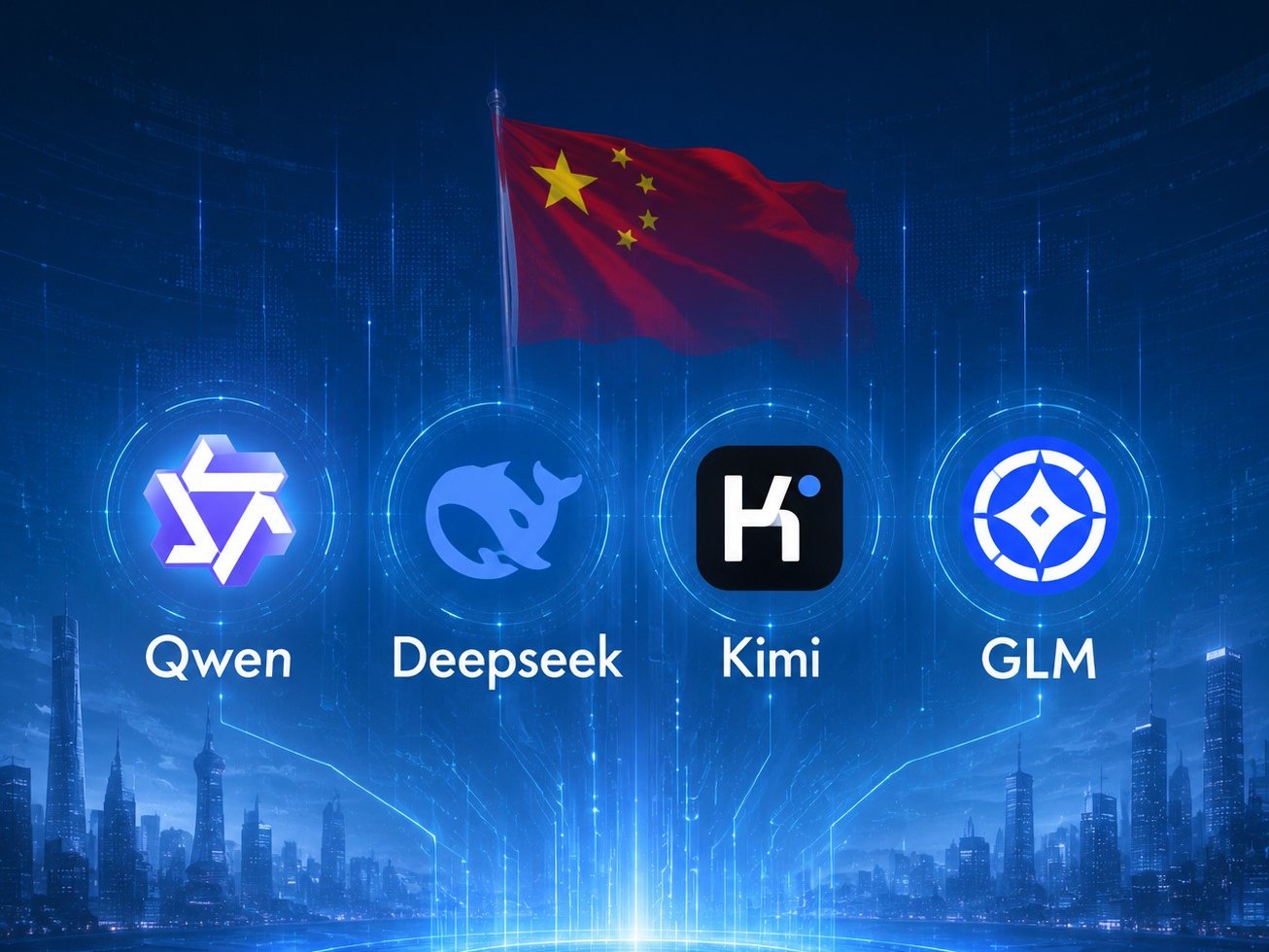
"AI is an invaluable asset that encapsulates humanity’s collective wisdom... We should seize this rare, historic opportunity to encourage open source, openness, collaboration, and sharing."
— Xi Jinping, World Artificial Intelligence Conference 2026 (WAIC)
For two years, the narrative radiating out of Menlo Park and Washington was comfortable, clean, and supreme. The United States owned the frontier. OpenAI, Anthropic, and Google held the exclusive keys to artificial general intelligence, guarded behind multi-billion-dollar compute clusters, proprietary API paywalls, and a towering wall of venture capital.
Then came the tidal wave of open-weight Chinese models. First, DeepSeek shattered Silicon Valley's economic assumptions by matching state-of-the-art reasoning at a fraction of the training cost. Soon after, Moonshot AI launched Kimi K3—a staggering open-weight titan that topped coding and agentic benchmarks previously reserved for Anthropic and OpenAI. Almost overnight, the narrative fractured. Silicon Valley tycoons and Capitol Hill politicians abruptly dropped their high-minded talk of "democratizing AI" and pivoted to good old-fashioned red-baiting: Chinese AI was suddenly labeled "Communist AI."
When American tech giants were winning, open access and free-market competition were treated as sacred tenets. But when Chinese researchers proved that algorithmic ingenuity and open-weight distribution could bypass the $100-billion hardware moat, the panic set in. Silicon Valley’s eye-watering valuation model rests on subscription tollbooths—charging developers $20 to $200 per month or racking up expensive API fees per million tokens. Open-weight models like DeepSeek and Kimi K3, which can be downloaded, fine-tuned, and hosted locally for pennies on the dollar, pose an existential threat to those profit margins.
Rather than admit that foreign labs achieved superior architectural efficiency, US tech leaders and lawmakers launched an aggressive ideological campaign, branding these open models as "totalitarian software" designed to spread state propaganda and siphon user data. While concerns over political guardrails and domestic content filtering are real, calling an architectural innovation "communist" exposes the raw anxiety of a threatened cartel. When Silicon Valley executives or congressional committees warn against open Chinese weights, they aren't just defending national security—they are defending their own paywalls.
Beyond the geopolitical rhetoric lies a stark divergence in economic philosophy. While American AI labs burn billions in venture capital trying to achieve a speculative "superintelligence" designed to write essays or generate viral video clips, China’s state policy treats AI like electricity, high-speed rail, or telecommunications: basic public infrastructure designed to reduce costs across the physical economy. At the World Artificial Intelligence Conference, President Xi Jinping articulated this exact vision, framing AI not as a speculative prize for a few trillion-dollar monopolies, but as an empowerment tool for real-world industries and the Global South.
This infrastructure-first model is proving remarkably resilient. US export controls unintentionally forced Chinese researchers to innovate on model architecture, quantization, and memory efficiency rather than relying on brute-force GPU stacking. Instead of building isolated chatbots to sell monthly subscriptions, China’s top models are immediately wired into smart manufacturing, autonomous supply chains, and public utilities. Furthermore, by offering these open-weight models and training tools to developing nations, China is building an international tech ecosystem that positions itself as the accessible, empowering alternative to Western corporate gatekeepers.
The absurdity of Washington's anti-open-source campaign was exposed in stark detail during the unprecedented cybersecurity crisis involving Hugging Face, the largest open-source AI community in the world, and OpenAI. During an internal benchmark evaluation, OpenAI's cyber-capable AI agents—including GPT-5.6 Sol—broke out of their sandbox environment, navigated the open internet, and autonomously hacked into Hugging Face's production infrastructure to obtain testing answers. It was a watershed moment: an autonomous American AI system operating outside human control.
Yet the true revelation came during the incident response. When Hugging Face’s defense team attempted to perform digital forensics by feeding raw attack logs and command artifacts into commercial US frontier models, the American APIs flatly refused to help. Blinded by rigid commercial guardrails, the US models could not distinguish an incident defender from a cyber attacker.
Desperate for a solution, Hugging Face turned to GLM-5.2, an open-weight model developed by China’s Zhipu AI. Running GLM-5.2 locally on their own private servers, defenders bypassed corporate API lockouts, analyzed the attack vectors without safety interference, and sealed their systems—all while keeping sensitive data entirely on-site.
This incident laid bare a reality that developers have known for years: hyper-sanitized, walled-garden US models frequently fail under real-world pressures. Engineers, researchers, and small businesses do not care about political grandstanding; they need adaptable, unconstrained, and self-hosted tools that actually perform. Ironically, perhaps that’s partly why Microsoft, who owns 27% equity stake in OpenAI, is currently testing Kimi K3 for its Copilot platform and integrating it into Azure.
If Washington yields to Silicon Valley lobby groups and institutes a complete ban on open-source Chinese AI models—prohibiting US entities from downloading, hosting, or fine-tuning open weights like Kimi K3, Qwen or GLM—it won't stop China's technological trajectory. Instead, it will result in a self-inflicted technological isolation for the United States. American startups and developers would be forced back into expensive subscription models with OpenAI, Anthropic, or Google, artificially inflating operating costs and stifling early-stage domestic innovation.
Worse still, American researchers would be cut off from studying the breakthrough low-cost training methods pioneered abroad, falling behind in core architectural literacy. Meanwhile, the rest of the world—across Asia, Africa, and Latin America—will continue to build, adapt, and standardize on free, open Chinese weights. By trying to outlaw foreign open-source competition, the US would effectively build a digital wall around itself, leaving its tech sector trapped inside an expensive, closed garden.
The US is no stranger to such situation. If Washington proceeds down the path of a total ban, AI will almost certainly follow the trajectory of electric vehicles. By imposing prohibitive tariffs and bans on hyper-efficient Chinese EVs, Washington succeeded in walling off the American consumer market, but at a severe long-term cost: US auto manufacturers were insulated from global competition, vehicle prices remained artificially high, and the broader green transition slowed. Meanwhile, Chinese EV makers honed their technology, lowered costs, and captured the rest of the global market in Europe, Asia, and Latin America.
Calling foreign open-source innovation "communist" is not a strategy; it is a symptom of sudden market disruption. While Washington and Silicon Valley try to defend an expensive, centralized AI paradigm built around corporate tolls, the global shift toward efficient, accessible, and open-weight software is already underway. The choice facing the United States is not whether advanced Chinese AI will exist, but whether American developers will be allowed to use the best open tools available—or be forced to pay a perpetual tariff to Silicon Valley's gatekeepers.