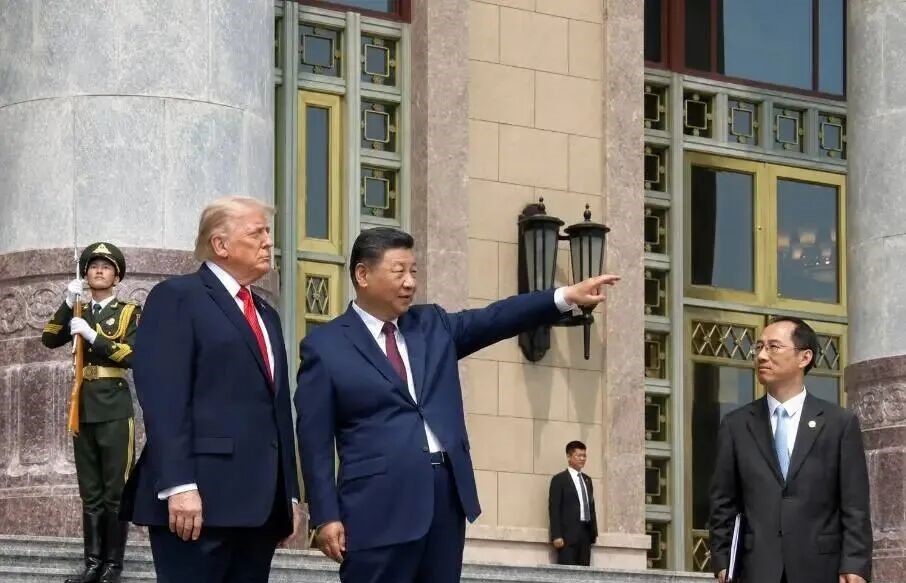
The state visit of United States President Donald Trump to the People’s Republic of China on May 14–15, 2026, represents a transformative juncture in twenty-first-century geopolitics, marking a transition from the unmitigated estrangement of the previous year toward a nascent framework of managed competition.
This summit, the first such high-level engagement in nearly a decade, occurred against a backdrop of severe global turbulence, including the US-Israeli conflict with Iran, a widening "peace deficit" in Europe and the Middle East, and a precarious global economic landscape characterized by high inflation and trade disruptions. For the Trump administration, the visit was an exercise in strongman diplomacy aimed at securing tangible economic concessions—the "big win" sought ahead of the 2026 midterm elections—while for the Chinese leadership under President Xi Jinping, it served as a platform to introduce "Constructive Strategic Stability" as the new guiding logic for bilateral relations.
The diplomatic climate preceding the May 2026 summit was defined by what many analysts termed an "uneasy calm" following the catastrophic economic frictions of 2025. During the first year of his second term, President Trump had unleashed a series of aggressive trade measures, including tariffs that peaked at 145% on certain Chinese goods, to which Beijing retaliated with its own 125% duties and a freeze on the export of rare earth metals. This cycle of painful retaliation eventually forced both capitals to recognize that while they possessed the capacity to harm one another, neither could do so without incurring unbearable domestic costs.
By early 2026, the strategic calculus in Washington was further complicated by the outbreak of war in the Middle East on February 28, which had shuttered the Strait of Hormuz and driven US inflation to a three-year high. Consequently, the Trump administration signaled an early and loud desire for multiple presidential encounters, hoping to leverage a business-first relationship to ease inflationary pressures and secure Chinese cooperation in reopening vital energy corridors.
The summit was therefore not merely a routine diplomatic event but a high-stakes effort to establish a "floor" for a relationship that appeared to be in freefall. Beijing’s willingness to host the US President, despite the previous year’s volatility, reflected its own domestic priorities, specifically the implementation of the 15th Five-Year Plan (2026–2030) and the need for a stable external environment to foster "high-quality development".
The most significant political outcome of the Beijing meetings was the consensus to adopt "Constructive Strategic Stability" as the new positioning for China-US relations. This framework, proposed by President Xi, is intended to guide bilateral ties for the next three years and beyond, essentially spanning the remainder of the current US administration and providing a buffer zone to escape unilateral American pressure.
The conceptual foundation of Constructive Strategic Stability is built upon what President Xi termed the "Four Stabilities," a layered approach designed to replace the Cold War-era focus on crisis management with a proactive, cooperation-oriented equilibrium.
Positive Stability centered on Cooperation: This dimension posits that the resilience of the relationship is derived from the breadth of its exchanges. By expanding the list of cooperation in non-sensitive fields such as public health, energy security, and agriculture, both sides can create a protective net that prevents disagreements from spiraling into conflict.
Sound Stability through Moderate Competition: Beijing acknowledges the inevitability of competition but argues it must be "healthy" and "within proper limits". This pillar emphasizes that competition should serve to make each side a "better version of itself" rather than aiming for the destruction or containment of the other, thereby avoiding the zero-sum mindset of the Thucydides Trap.
Constant Stability through Manageable Differences: This requires both nations to maintain policy continuity and honor their commitments. It aims to eliminate the rollercoaster nature of bilateral relations, advocating for a normal stability where disagreements are compartmentalized and addressed through "equal-footed consultation".
Enduring Stability with the Promise of Peace: The ultimate goal is the achievement of "peaceful coexistence," which is identified as the "greatest common denominator" between the two powers. This entails a mutual respect for differing social systems, development paths, and "core interests," ensuring that confrontation never escalates into war.
During the summit, the Chinese leadership emphasized that this new positioning must not remain a slogan but must translate into "concrete actions". The practical application of this framework was visible in the business-first atmosphere of the visit, where President Trump was accompanied by an unprecedented delegation of American corporate leaders. This corporate presence served a dual purpose: it provided Trump with the optics of economic success and offered Beijing a mechanism to deepen the intertwining of interests that makes decoupling increasingly difficult.
The inclusion of tech giants like Nvidia and Tesla alongside traditional industrial and financial leaders indicates that the Strategic Stability framework is being tested first in the economic arena. Premier Li Qiang’s subsequent meeting with these leaders reinforced the message that China's "door will open wider," inviting American businesses to participate in the 15th Five-Year Plan's growth potential.
Despite the shift toward economic pragmatism, the summit was punctuated by sharp warnings regarding the core concerns that threaten to undermine any nascent stability. The status of Taiwan and the resolution of the war in Iran emerged as the primary geopolitical hurdles to the implementation of the "Four Stabilities".
President Xi used the summit to issue his most blunt warning to date regarding Taiwan, calling it the "most important issue" in China-US relations. He cautioned that while proper handling could maintain overall stability, "mishandling" it would lead to "clashes and even conflicts," putting the entire relationship in "great jeopardy".
The Chinese objective was clearly to leverage the Strategic Stability framework to pressure the Trump administration into exercising extra caution regarding arms sales. Specifically, Beijing sought to forestall a pending $14 billion US arms package for Taiwan, which followed a previous $11.1 billion deal unveiled in late 2025. While Trump made no commitment either way during the flight home, the optics of the summit and the focus on personal diplomacy raised concerns among allies that the administration might be viewing Taiwan as a transactional bargaining chip in a broader "G2" arrangement.
The US-Israeli war with Iran provided a different kind of test for the Strategic Stability framework. Unlike Taiwan, where interests are fundamentally opposed, both Washington and Beijing share a pragmatic need to keep the Strait of Hormuz open to energy flows. Trump sought Chinese pressure on Tehran to reopen the waterway, given that China remains the largest buyer of Iranian oil despite the US blockade.
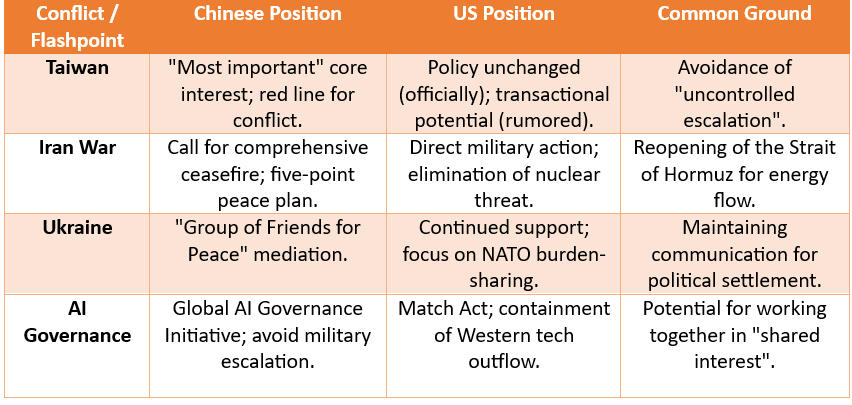
The summit readout indicated a rare convergence: both leaders agreed that "Iran can never have a nuclear weapon" and that the "Strait of Hormuz must remain open". Xi expressed a specific interest in purchasing more American oil as a way to reduce China's future reliance on the unstable Gulf routes, a move that would simultaneously help Trump lower domestic fuel prices—a classic "win-win" in the language of the new stability framework.
The 2026 summit occurred at a time when China is actively rebranding itself from a rising power into an anchor for world peace and security. This shift is formalised through the Global Security Initiative (GSI), which aims to offer "Chinese wisdom and solutions" to international conflicts that have left Western-led frameworks mired in a "security dilemma".
The GSI advocates a vision of "common, comprehensive, cooperative, and sustainable security," explicitly rejecting hegemonism, power politics, and unilateralism. Its implementation between 2024 and 2026 has been marked by several high-profile mediation efforts that have significantly elevated China's standing in the Global South.
Middle East De-escalation: Beyond the Saudi-Iran reconciliation facilitated in 2023, China has more recently facilitated the Beijing Declaration signed by Palestinian factions and, alongside Pakistan, issued Five Proposals for restoring peace in the Gulf. These proposals emphasize the safety of navigation and the primacy of the UN Charter, positioning China as a champion of international law.
The Ukraine Crisis: China has promoted the establishment of the Group of Friends for Peace, an UN-based coalition of over a dozen African and Latin American countries. This group advocates for a six-point peace plan and works to create the conditions and foster consensus for a political settlement, with Chinese diplomats noting that the window for negotiation is open as of early 2026.
Regional Mediation: Beijing has played a constructive role in resolving the conflict between Cambodia and Thailand and has continued to mediate in hotspot issues in northern Myanmar, Afghanistan, and the Korean Peninsula.
A core tenet of China's peace-keeping role is the belief that "development is the master key to solving security issues". This logic underpins the synergy between the Global Security Initiative (GSI) and the Global Development Initiative (GDI). By using the Belt and Road Initiative (BRI) and the Global Development and South-South Cooperation Fund, China seeks to empower developing countries, arguing that economic prosperity is the only sustainable foundation for lasting peace. This Chinese approach to hotspot issues avoids interference in internal affairs, focusing instead on addressing both symptoms and root causes through economic integration.
China’s influence at the United Nations has expanded proportionally with its financial contributions, although this growth has introduced new frictions. By 2025, China had become the second-largest contributor to both the UN’s regular budget and its peacekeeping operations budget, trailing only the United States.
This rise in "assessed contributions" (mandatory treaty obligations) has given China significant leverage in UN restructuring and appointments. However, the 2026 fiscal year faces a "pretty huge liquidity crisis" as both top contributors are significantly in arrears. While the US Congress has debated eliminating its 2026 peacekeeping contribution entirely, China’s late settlements have also drawn criticism. Furthermore, Western commentators point out that China’s "voluntary contributions" to humanitarian agencies remain "negligible" relative to its size, suggesting that Beijing prefers to channel its peace-building funds through its own initiatives rather than UN-led humanitarian missions.
Despite these financial tensions, China remains the largest contributor of peacekeeping personnel among the five permanent members of the Security Council. This boots on the ground commitment, combined with its role as an anchor for stability, allows Beijing to frame its global role as one of a responsible major power that provides precious certainty in a turbulent world.
The shift toward a business-first relationship and the adoption of Strategic Stability has elicited a spectrum of reactions from global actors, ranging from cautious optimism to existential anxiety.
For the European Union, the Xi-Trump summit carried a warning for Brussels. While any reduction in great-power tension is welcomed, there is a profound fear that Washington and Beijing are entering a phase of direct transactional bargaining that will leave Europe "outside the room".
European planners are particularly concerned about diversionary effects: if Chinese exports are curtailed in the US market through bilateral deals, they may be pushed toward Europe, threatening manufacturers of electric vehicles, batteries, and steel. The message from Beijing to Brussels was clear: the EU must become more strategically capable or risk becoming a mere payer of costs rather than a shaper of outcomes, as they are in the Hormuz Crisis and Ukraine War.
In Japan and South Korea, the summit signaled the possible arrival of a "G2 era" in which Washington and Beijing share global hegemony, potentially at the expense of regional allies. Trump’s remarks identifying the US and China as the "two superpowers" and the "strongest nations on Earth" were seen as an echo of Chinese-led concepts of "major power relations".
Japan, in particular, is watching anxiously as this shift could accelerate a need for Tokyo to bolster its own Indo-Pacific strategy. The concern is that if the US and China reach a strategic stability agreement, Washington might reduce its military footprint in the region or soften its stance on the red line of Taiwan in exchange for trade concessions.
The summit also addressed the intricate and intractable nature of technological competition. While the leaders touted their personal rapport, the underlying "Match Act" introduced by US lawmakers in early April 2026 continues to hinder China's access to Western chip technology. This act targets Dutch company ASML, aiming to ban not only the sale of deep ultraviolet (DUV) systems but also the maintenance of equipment already delivered to China.
Beijing’s retaliation through export controls on rare earth metals—of which it controls 70% of global production and nearly 90% of refining capacity—illustrates that it still wields significant economic leverage. However, the summit suggested a desire to compartmentalize these tech wars. By signaling a willingness to discuss AI at the head-of-state level, both leaders are attempting to find a buffer zone where technological competition can be healthy rather than catastrophic.
The May 2026 summit in Beijing is merely the first chapter in what is intended to be a series of high-level engagements. President Xi is scheduled to pay a reciprocal state visit to the United States in the autumn of 2026, and both leaders have pledged support for the upcoming APEC and G20 summits.
The success of Constructive Strategic Stability will be measured by whether these "four stabilities" can survive the inevitable shocks of the coming years. For Beijing, the goal is to use this "interregnum" to enhance its position and escape the Thucydides Trap by forcing a more equal dialogue. For the Trump administration, the objective remains the "consummate deal," using personal diplomacy to secure economic advantages while muddling through geopolitical impasses like Iran and Taiwan.
The transition toward a business-first relationship, underpinned by the framework of Constructive Strategic Stability, represents a pragmatic realization by both the United States and China that total confrontation is currently unbearable. While the summit did not resolve the fundamental contradictions over Taiwan or technological supremacy, it established a new positioning that provides the international community with a necessary public good of predictability.
China's larger role in keeping peace—through its Global Security Initiative, mediation in the Middle East and Ukraine, and its significant contributions to the United Nations—complements this bilateral stability. By positioning itself as a responsible major power that prioritizes dialogue over confrontation and partnership over alliance, Beijing is successfully challenging the traditional hegemony of Western-led security architectures.
Ultimately, the 2026 Beijing Summit has redefined the most consequential relationship in the world. It is no longer a relationship defined solely by its conflicts, but one that is attempting to build a protective net of economic interest and strategic stability. Whether this framework can survive the "storms and reefs" of the next three years—and the inevitable shift in American policy after 2029—remains the central question for the future of global peace. For now, the giant ship of China-US relations has been steered away from immediate collision, providing a dawn of peace for a world desperately in need of certainty.