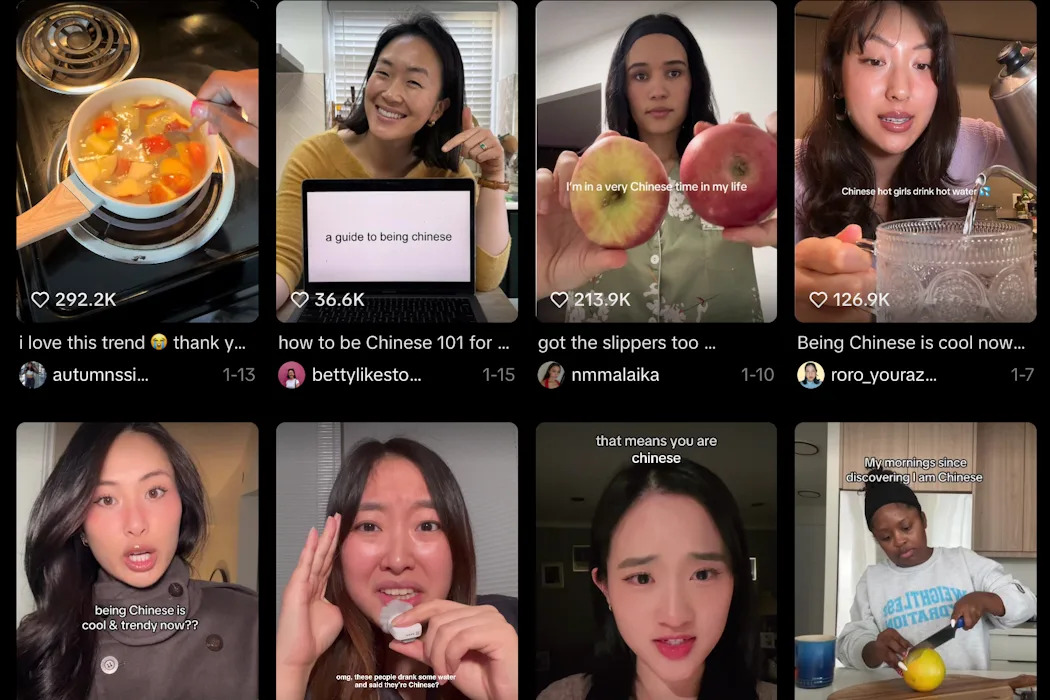
On TikTok, a young woman in suburban America films herself starting the day not with an iced coffee, but with a thermos of hot water. "You met me at a very Chinese time in my life," the caption reads, as she slips into house slippers and begins a slow, rhythmic set of Baduanjin qigong exercises. This is not an isolated eccentricity; it is part of a sprawling, viral social media phenomenon dubbed "Becoming Chinese" or "Chinamaxxing."
From TikTok influencers like Sherry (@sherryxiiruii), whose videos on adopting TCM-based wellness habits have garnered millions of views, to massive YouTube streamers like IShowSpeed, whose unfiltered, chaotic live streams from Chinese cities have exposed tens of millions to a modern, dynamic side of the country rarely seen in mainstream Western media, the digital landscape is shifting. This isn't just about enjoying soup dumplings; it's a complex, multifaceted trend that offers a fascinating window into changing global perceptions, the rise of China's cultural cachet, and the concurrent erosion of Western cultural hegemony.
Unlike previous "China crazes" that focused on exoticized symbols or grand national spectacles, this current trend is characterized by a grass-roots, peer-to-peer adoption of practical, daily lifestyle habits rooted in both traditional Chinese wisdom and the country's modern technological infrastructure.
At its core, the trend serves as a digital vessel for exploring an alternative model of modern living, frequently framed in direct opposition to perceived social and political instability in the West.
The "Becoming Chinese" trend was catalyzed by a new generation of digital creators who leveraged the algorithmic logic of short-video platforms to present Chinese culture as an accessible and aspirational lifestyle. Sherry Zhu, a 23-year-old Chinese American content creator based in New Jersey, emerged as a central figure in this movement. Her series of tongue-in-cheek tutorials on how to embody the "Chinese baddie" or "become Chinese" through daily routines—such as boiling apples for digestive health, wearing house slippers to maintain internal warmth, and utilizing goji berry concoctions—garnered over twenty million views within a few months. Her content operates through a blend of humor and earnest wellness advocacy, instructing non-Chinese viewers that "resisting it now is pointless" as they transition into a "highly Chinese era" of their lives.
This movement is further bolstered by the unscripted narratives of high-profile Western influencers who have traveled to China under increasingly liberalized visa policies. The 2025 China Tour of American streamer IShowSpeed serves as a primary example of this "para-diplomatic" engagement. His livestreams from major Chinese metropolises provided tens of millions of viewers with an unfiltered view of modern Chinese life, showcasing futuristic skylines, high-speed rail, and seamless mobile payment systems. Such content acts as a powerful counter-narrative to traditional Western media framing, which frequently emphasizes political friction or economic threat. By focusing on the "cyberpunk" aesthetics of cities like Chongqing and the pervasive sense of public safety, these influencers cultivate an "affective response" among global Gen Z audiences, who begin to view China as a land of modernity and opportunity rather than a distant geopolitical rival.
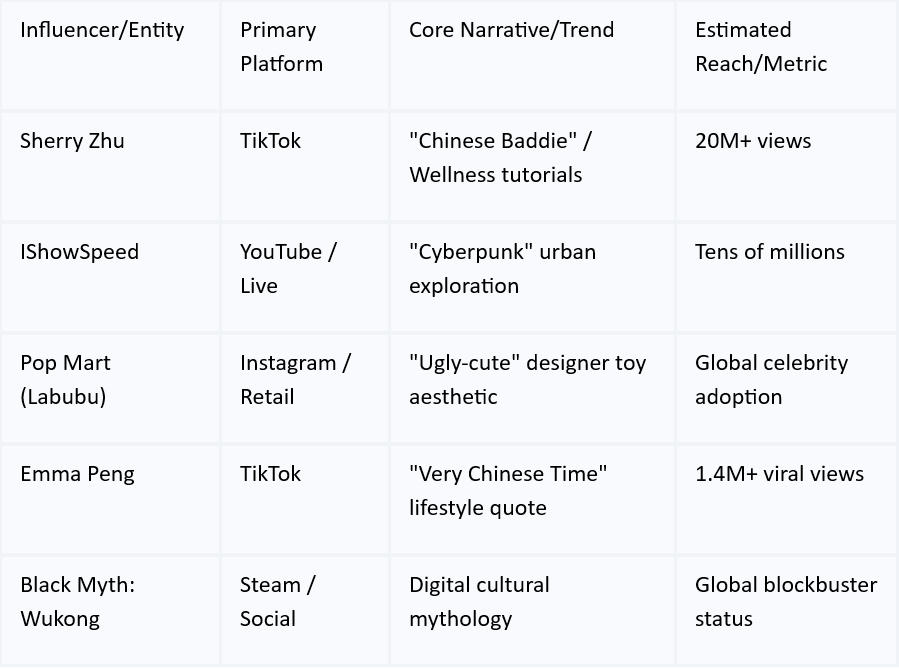
The aesthetic appeal extends beyond digital content into the realm of physical consumption and "China-chic" (Guochao) products. The global success of the Labubu "ugly-cute" doll, created by Hong Kong-born illustrator Kasing Lung and propelled by the Chinese brand Pop Mart, illustrates how Chinese creativity is increasingly defining "cool" on a global scale. Brandished by celebrities such as Blackpink's Lisa and David Beckham, these products signify a shift where "Made in China" no longer evokes purely industrial production but instead represents a sophisticated experiential life aesthetic.
The term "Chinamaxxing"—derived from gaming slang "maxxing," which refers to maximizing a specific attribute—represents the extreme adoption of Chinese lifestyle practices to optimize one's own physical and mental well-being. This trend focuses on the "micro-level of daily life," prioritizing tangible habits over grand ideological statements. Central to this movement is the integration of Traditional Chinese Medicine (TCM) concepts, particularly the principle of "preventive treatment of disease" (治未病).
Participants in the trend playfully embrace routines such as:
Hydration Awareness: Carrying thermoses to drink hot water or herbal teas, specifically ginger and red date concoctions, to maintain internal equilibrium.
Thermodynamic Health: Strict adherence to wearing slippers indoors and protecting the "Jing" (vital essence) by avoiding cold floors and maintaining consistent sleep patterns.
Low-Impact Exercise: The viral spread of Ba Duan Jin (eight-section brocade) and Tai Chi tutorials, which are presented as practical buffers against the pressures of a "burnout society".
Domestic Poetics: Finding joy in the "quiet wisdom" of simple chores, such as using rice cookers or preparing home-cooked meals such as the pudding-like steamed egg custard and congee.
This shift from distanced observation to active, participatory identification marks a significant evolution in cultural recognition. As Professor Zhu Wei of the China University of Political Science and Law observes, the seriousness with which Western netizens are now adopting these lifestyles is a direct response to the "fatigue" emerging from dominant Western logics of living. In a world characterized by rapid change and digital saturation, the Chinese way of life is perceived to offer a solution rooted in order, moderation, and inner stability.
The "Becoming Chinese" trend is inextricably linked to the dominance of Chinese-built social networking platforms and the specific algorithmic environment they cultivate. TikTok and RedNote have become the primary battlegrounds for this cultural shift, functioning as spaces where "TikTok refugees" and global youth can engage with Chinese content outside the traditional filters of Western mainstream media. Research suggests that these platforms' recommendation systems are designed to reward content that generates high levels of cross-cultural curiosity and engagement, effectively amplifying narratives that challenge entrenched stereotypes.
This digital shift has facilitated a "de-Westernization" of social media discourse. While Western platforms (Facebook, X, Instagram) have historically acted as the primary projectors of cultural hegemony, the rise of Chinese platforms has created a parallel digital ecosystem where Chinese cultural subjectivity can be negotiated and expressed. This transition is reflected in the shift from "GAFAM" (Google, Apple, Facebook, Amazon, Microsoft) hegemony to the inclusion of "BAT" (Baidu, Alibaba, Tencent) and ByteDance in the global brand hierarchy.
Furthermore, the integration of Chinese AI technologies, such as the DeepSeek large language model, into global daily routines has reinforced this technological alignment. Users worldwide increasingly utilize these tools for real-time translation, personalized wellness tips, and creative collaboration, thereby embedding Chinese intellectual and technological output into the fabric of global digital existence.
While the "Becoming Chinese" movement possesses a strong grassroots component, it is meticulously supported by a sophisticated, multi-tiered institutional strategy developed by CCP. The shift from central-level publicity to a "Centralization+" model has led to the establishment of over 200 International Communication Centers (ICCs) at the provincial, city, and county levels. These centers operate as "fusion hubs" that coordinate local media, businesses, and academic resources to push tailored, issue-specific messaging to global audiences.
A primary tool of these ICCs is "influencer diplomacy." Centers like the Western China International Communication Organization (WCICO) in Chongqing actively invite foreign influencers and content creators on curated tours. These trips are designed to produce testimonials that emphasize China's technological advancements, religious freedom (often through mosque visits in Xinjiang), and cultural richness. By leveraging the voices of popular foreign figures who possess massive followings in regions like Southeast Asia, Africa, and the Middle East, the Chinese state aims to create a nuanced narrative that portrays China as a modern and friendly partner.
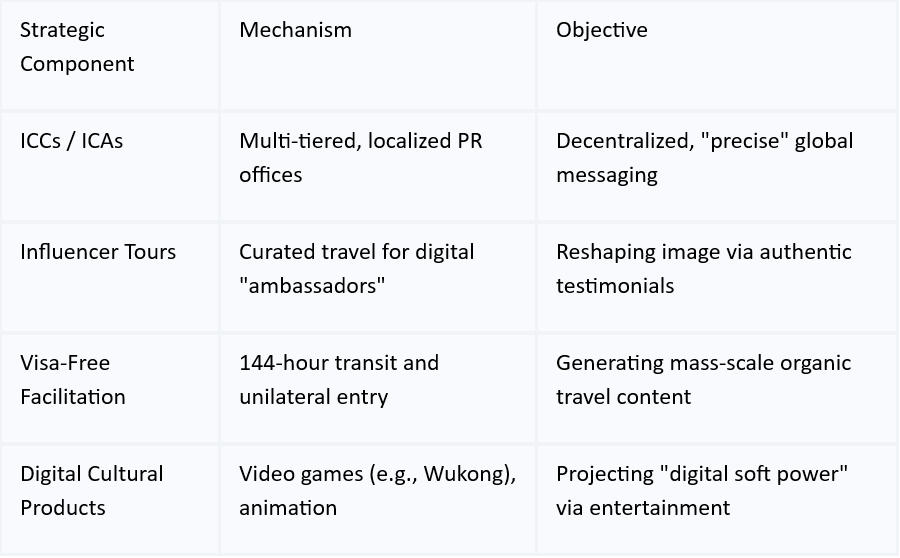
The implementation of visa-free policies serves as a significant force multiplier for this strategy. The expansion of the 144-hour visa-free transit policy to 54 countries and the introduction of 15-day unilateral visa-free entry for various European and Asian nations have led to a surge in inbound tourism. In 2024, China recorded 20.115 million visa-free entries, a year-on-year increase of 112.3%. This "China Travel" phenomenon has flooded social media with organic, first-person vlogs of travelers marveling at the efficiency of Chinese society, the safety of its streets, and the convenience of its payment systems.
The "Becoming Chinese" trend is deeply symptomatic of a broader shift in the global power distribution, often referred to in Chinese discourse as "a rising East and a declining Western hegemon". For many Western participants, the embrace of Chinese lifestyle habits is framed in direct opposition to a perceived "American century of humiliation," marked by political division, failing infrastructure, and social fragmentation.
Observers, such as researcher Caroline Ouellette, suggest that participants are engaging with a "hyperreal China"—a symbolic version of the country that serves as a container for everything Westerners fear they are losing: "community, structure, competence, limits, cultural continuity, and care for elders". In this context, China is not viewed through the lens of political ideology but as a "credible alternative" to a Western system.
The comparison between Chinese and Western infrastructure has become a dominant theme in the "Becoming Chinese" discourse. Vlogs highlighting the "cyberpunk" aesthetic of Chongqing or the sleek efficiency of the Shanghai Maglev are often juxtaposed with critiques of the "dumpster fire" state of Western urban environments. The ability of a foreigner to navigate China using only a mobile phone for all payments is frequently cited as a "magical" or "futuristic" experience, highlighting the stagnation of Western financial and digital services.
The "Becoming Chinese" trend has not been without controversy, particularly within the Chinese diaspora and among social critics. For many Asian Americans, the sudden trendiness of cultural markers that were previously stigmatized—such as "stinky" foods or traditional wellness practices—can feel "jarring" and insincere. The term "eating the other," coined by feminist author Bell Hooks, is frequently used to describe how dominant groups "consume" marginalized cultures to enhance their own "white palate" without acknowledging the history of racism or systemic exclusion.
Critiques of the trend include:
Performative Consumption: The concern that participants are adopting "surface-level stuff" (like eating hot pot or learning Nihao) to avoid FOMO (fear of missing out) without internalizing or respecting the actual depth of the culture.
Erasure of Complexity: The "hyperreal" version of China presented online often omits the "hard bits" of Chinese life, such as generational trauma, the "bamboo ceiling" in the West, or the complicated political history of the mainland.
Commodification: The risk that traditional practices like Hanfu or tea ceremonies are being reduced to "internet fads" or "bite-sized, easily digestible pieces" for Western consumption.
Despite these criticisms, some creators view the trend as an opportunity for genuine cross-cultural engagement. Jimmy O. Yang's blending of US streetwear with a Chinese Tang jacket, or the "New Chinese Style" (新中式) fashion movement, represents a creative hybridization that allows second-generation diaspora members to reconnect with their heritage in a modern context. For these individuals, the trend is not an appropriation but a "reclaiming of cultural narrative" through design and lifestyle.
A distinct and highly influential subset of China's digital soft power is the "New Farmer" movement. Influencers such as Li Ziqi and Dianxi Xiaoge have transformed the "pastoral simplicity" of rural China into a global digital phenomenon. By documenting traditional farming methods, seasonal cooking, and handicraft, these creators paint a "retro-utopian" vision of the countryside as an idyllic escape and a thriving cultural hub.
This movement serves several domestic and international functions:
Rural Revitalization: It aligns with Beijing's strategy to narrow urban-rural gaps and encourage the "digital-savvy" to return to their roots.
Aesthetic Alternative: It offers a "feast of bucolic bliss" to urbanites worldwide, capitalizing on a universal yearning for connection to nature and authenticity.
Countering "Poverty" Narratives: It upends Western preconceptions of the Chinese countryside as a hinterland of stagnation, presenting it instead as a sophisticated repository of "ancient wisdom".
The "New Farmer" content is highly curated, often blurring the line between genuine representation and "curated fantasy". Nevertheless, its popularity among Western audiences—many of whom are disillusioned with hyper-industrialized life—further reinforces the idea that the Chinese way of life offers a more meaningful and balanced existence.
The "Becoming Chinese" trend represents the emergence of "Soft Power 2.0"—a model that moves beyond grand state-sponsored projects toward an "all-of-society" approach to cultural dissemination. This model is characterized by its integration into the mundane and the everyday, making "Chineseness" an inclusive global cultural phenomenon rather than a static national identity.
According to the Brand Finance Global Soft Power Index 2025, China's international status has risen to second place worldwide, surpassing the United Kingdom. This rise is not accidental but is the result of a clear national vision, as outlined in the recommendations for China's 15th Five-Year Plan (2026-2030), which aims to build a "flourishing culture" and achieve a "continued rise in soft power".
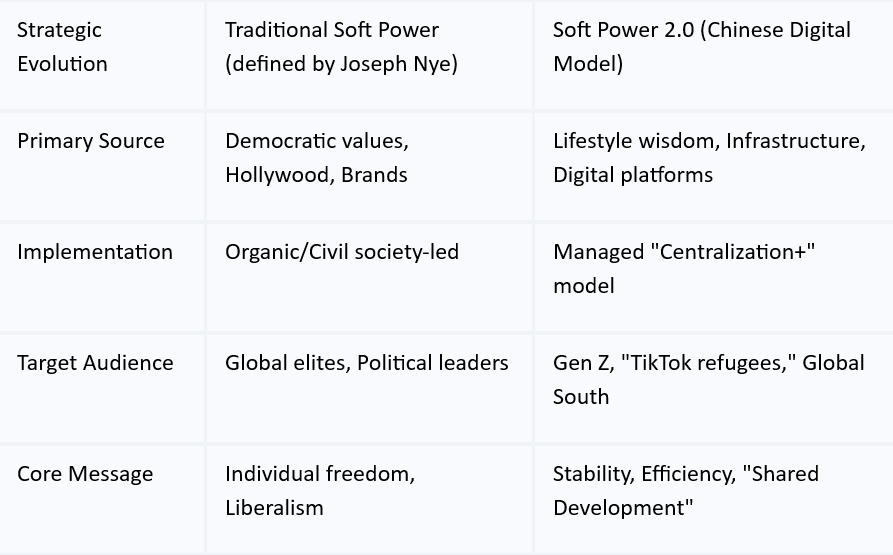
The "Becoming Chinese" movement demonstrates that cultural appeal is shifting from "grand symbolic representations" to the "micro-level of daily life". When ordinary everyday moments—a cup of hot water, a pair of slippers, a ride on a high-speed train—are seen and recognized by millions, the attraction of "Chineseness" transcends simple symbolic imitation. It becomes a new normal that expands far beyond the online crowd.
Ultimately, the trend reflects a fundamental "resonance"—a pull from the depth of Chinese living wisdom and a push from the fractures in Western societies. As Western governments continue to struggle with internal division and crumbling infrastructure, the "Becoming Chinese" trend provides a digital window into a society that projects the opposite: unwavering stability, technological competence, and a deep, practical connection to cultural heritage. Whether this movement remains a "playful and fleeting trend" or evolves into a more permanent shift in global lifestyle aspirations will depend on the continued dominance of Chinese technology and the West's ability to address its own growing "soft-power deficit". For now, the "Very Chinese Time" of the mid-2020s serves as a powerful testament to the reconfiguring of global cultural hegemony in the digital age.